Showing posts with label high school math. Show all posts

Tuesday, January 24, 2017

Blended Learning: Lessons Learned


One of my biggest regret after moving districts this year was that I never sat down and put all the lessons I'd learned as a blended learning teacher together in one place. Luckily for me, at the end of last year I got to sit down with the people at Opportunity Culture, the group that had been instrumental in helping my district move towards blended learning. They put together this vignette summarizing my experiences and my best advice to new blended learning teachers. 


Pioneering Blended-Learning Teachers Reach More Students Vignette Series
A vignette written about my experiences with blended learning in Pre-Calculus. If you want my lessons learned (often the hard way), read this! 

I'm so thankful to have had this experience and to have had it documented! 

Hey! I said that! 


Thursday, January 19, 2017

Choosing a Method of Integration

One of the biggest difficulties my students face when we work through our integration unit is distinguishing between the different techniques we've learned. When told which approach to take, they can nail almost any integral. When given a mixed bag of problems to sort through on their own, the tides start to turn. I tried to spiral in a bit more mixed practice than I did last year, but it still didn't feel like quite a enough this year.

I designed this to have kids work on in phases-
1) Individually evaluate which method you would use (gut instinct, what do you think?)
2) Swap papers with a partner and say whether you agree or disagree and be ready to argue why
3) Work with your partner to try to decide on who is right. Check yourself by evaluating the integral
4) Generate a list of what features helped you identify which method to use!

I wish I'd left more time to do it in class. I will definitely budget more for it next year. 


Any other favorite activities for helping kids with this?


Monday, May 2, 2016

The Final Countdown: AP Week is Here!

Here's the motto I'm trying to instill in my kiddos this week:

During the middle of last year, a colleague and I were discussing the fact that our school only offered BC Calculus and we wished there was an option for students who were interested in pursuing Calculus but might not be ready for the demand of BC. Heck, my bachelor's is in pure mathematics and I did just fine having only been a product of AB Calculus. We approached our administration about this and luckily for both ourselves and our kids, they allowed us to take on the challenge of designing and implementing a full-year AB course. The course would be an "Honors Calculus" course in the fall, leading directly into an AB course in the spring.  It took some selling to get our enrollment up and I am forever grateful to the 20 kids who took the risk of a brand new Calculus course with me. The enrollment is already more than doubled for next year and that definitely wouldn't have been possible without this pilot group. 

I feel a little like the cast of one of those youth sports movies sometimes when we are in class- despite the fact that Emilio Estevez had consistently better hair than me in any number of those movies.  We are an unlikely mix.....17 boys and 3 girls (I promise our demographics are more evenly split for next year!!) with extraordinary variation in past experience with math, intrinsic motivation, and consistency in completing tasks. But they all showed up every day and tried. Cue the Mighty Duck's-esque montage where everyone learns that "Ducks Fly Together" and learn to skate without falling.  I've gotten to watch this unlikely mix of kiddos turn into a team who can function at a really high level (or more concretely, get about 5 to 9 points on the famous 2007 AB 3 problem).

Because of the extra time built into our course, I really do feel like I've given the kids all the tools I possibly can at this point in the game. I'm okay with not trying to "cram" any extra information in their brains on the last day....which is a feeling of peace as a teacher that I don't normally feel. With my unlikely group of mathematicians and the mindset that we've prepared with the most gusto we possibly could, I'm taking a very different approach on our last day in class tomorrow. Here's the plan:

1) A sincere "thank you"
Y'all.....I'm so proud of these kids. Because I teach mostly in a STEM program, this is the third straight year I've taught this particular group of 20 and they've been a huge part of my journey as an educator. Beyond all of that, they've been with me through an incredibly difficult year personally. They've accepted me on my bad days and pushed me to be better even on my best days. They've driven me a little crazy, of course. But I am so grateful for the hard work and determination I've seen from each and every one of them. They've made me laugh and learn and grow. I don't know if we ever thank our kids enough. I'm trying to remember to do it more. 
Good Luck Gift Bags (because my inner middle school teacher still hides deep below the surface)
2) A little more shop talk
Because I don't think you can emphasize "DO NOT write 'it' if you mean f'(x)!!!!" enough. I don't mind saying it for the 16,000,001st time if it means they remember. And for Heaven's sake, don't leave off the + C !

3) A real, honest talk about anxiety, nerves, and some brain chemistry
Here's why: I am someone that naturally appears incredibly collected and outgoing. I seem to thrive on being constantly interacting with others. This is a completely intentional choice I make everyday- I am much more of an introvert than anyone would suspect.  It was actually my time as an AP student that started my journey to discovering this. AP US History basically turned me into a robot; it was the highest expectations to which I'd ever been held in a subject area that wasn't my strength. Friends tried to talk some sense into me, but I assumed it was just stress and it would pass. As I got older, I started to become more cognizant of the amount of anxiety I felt on a regular basis (although I'd still fight you if you tried to tell me I was at all abnormal in what I felt). Only this year did my anxiety finally bubble over into something I needed to address and doing so has totally changed my perspective. 

I think a lot of kids feel this kind of anxiety and pressure. Our guidance counselors get crying AP students in their room regularly. We expect to see some mini-breakdowns as exams approach. And let's be real....most 16 and 17 year olds aren't equipped to deal with it. So here's what we're doing:


Activity #1:  Article Reading
I'm going to have the kids read this silently, marking a "?" next to anything they have questions about and a "!" next to anything they want to remember for the test. Then we're just going to talk and see where it goes. 

Activity #2: Journaling Activity
Since my very first standardized testing week as a 1st year teacher, this article has been in my arsenal. I love it. I love the idea that psychologically the symptoms of being "pumped" are the same as being terrified.  I try to get kids to get pumped to show what they know, not fear what they might not know. 
"In a study published last year in the journal Emotion, Dr. Beilock and four co-authors found that with students anxious about math, the more stress hormone they produced, the worse they did on a test; students with low math anxiety did better the more cortisol they produced. “The first group,” she said, “felt the rising anxiety in their bodies and reacted by thinking, ‘I’m really nervous about this test. I’m afraid I’ll fail.’ ” They choked. “The second group told themselves something like, ‘I’m really psyched up for this test! I’m ready to go!’ ” Dr. Beilock recommends consciously adopting positive self-talk. Remind yourself that damp palms and a pounding heart accompany all kinds of enjoyable experiences: riding a roller coaster, winning a sports match, talking to someone you have a crush on."
We are going to end the class by actually doing the journaling activity as an exit ticket. I am encouraging each of them to leave their fears in my classroom by writing them down and putting them into a box. With those left behind, I am going to encourage them to take only their knowledge, skill, and confidence with them into the test. My hope is after the exam we look at some of their fears and see if they were worth "carrying" with us or if in retrospect it was okay to leave them behind. 

I'm incredibly proud of them and am hoping to leave them feeling excited to show all they've learned. Any I will definitely be reflecting with them on how to make the course better. 

Good luck to everyone's AP classes these next 2 weeks! Cheers to all your work to prepare an incredible group of kids for an incredible challenge! 


Wednesday, February 24, 2016

Rationals Slap Jack Review

This year more than ever, I have a wide range of learners in my room. The individual needs of these kiddos means that I need to choose activities that can "run themselves" so that I can take small groups or individuals aside and work with them. Test review days, especially, seem to run this way. 

Here is an activity that I created for our class review today so I could pull together some small groups. I printed them front to back (they line up when printed), then cut a set for each small group:


The rules are this:
  • Students play in 2 vs. 2 games (so 4 students per group)
  • Students look at the 1st card and work with their partner to solve the problem completely on their whiteboard or in their notes
  • First group to have a complete solution written can "slap" the deck to indicate they're done. They then have to defend their answer. If they're right, they get to keep the card. If not, the other group gets a chance to "steal" by getting the question right. 
    • If no one gets it right, the whole group has to work to figure the problem out. No one gets the card, but they're still responsible for the topic. 
  • Group with the most cards at the end wins! 
I also gave each group a stack of red, yellow, and green cups to indicate if they needed help or not. Thank you, Math=Love for this great idea! 

What worked?
  • It's easy to differentiate by removing certain questions from the deck for some groups or by adding in enrichment cards (which I need to get around to making) for the stronger groups
  • I can move around the room or pull small groups aside and the activity flows pretty smoothly
  • Some groups chose to not actually play the game. Instead, they decided to sort them by what was easy and what was hard and go through the harder ones. 
  • The cups!! The cups!! Seriously, if you don't already do this, start. It will stop you from hearing your name frantically 47,214 times in the same period. 

What needs improvement? 

  • I will definitely group more strategically next time. I had 1 or 2 kids who were fish out of water with their group and were scared to use the cup to indicate they were confused if no one else was. 
  • I honestly needed a prize to rush them a little bit more to "play"- some kids take it so seriously, they can't have fun with it
Overall, another awesome day with my kiddos! 

Thursday, September 24, 2015

Rational Functions Challenges!

I always find my Pre-Calculus class the most challenging to teach at this time of year. Yes, even more so than prepping for AP Calculus for the first time and teaching a blended class with 50 students and about 10,000 things to grade every night. 

Why, you ask?

We run on block scheduling and there are few things which I think are more of a challenge for mathematics teachers than the gaps in background knowledge that happen from skipping semesters (or YEARS) of math in high school. By the time the kiddos get to me in 11th or 12 grade, all those "must know" skills have been forgotten. My goal is to try to remind them of those skills without having to reteach the concept completely. I know it's in there....we just need to bring it back to the surface!

We are currently studying rational functions, a topic which is so vital to their study of limits and later calculus. The whole idea of discontinuities....so important! 

This year for some of the review topics, I'm using some classroom flipping (with videos I made with Educreations). Kids who remember the material can speed through these and demonstrate mastery while kids who need the extra remediation have the opportunity to get it. My kids had 2 "flips" last night- a brief video on holes vs. asymptotes and one on horizontal asymptotes. Having the preview of these topics allows me to group the kids strategically and have them really practice in class. 

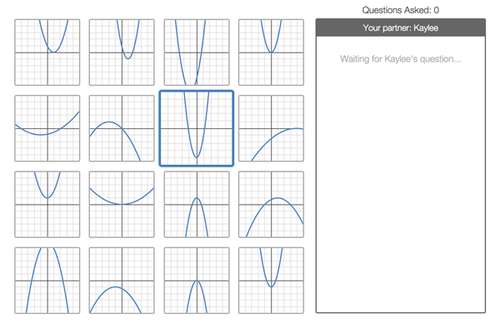
Desmos PolyGraph Activity 
Think "Guess Who?" for functions (the one pictured above is quadratics)! I loved that it let me move around the room and assess the comfort level with mathematical vocabulary.

We had a big discussion about what questions would be considered appropriate for pre-calculus level students. Here's what we decided...


From the teacher perspective, I could follow each conversation and make sure they were using academic vocabulary. I was able to circulate around the room and listen and ask probing questions to kids who needed it. It was competitive, but fun! Every single one of my students said on their feedback form for the activity they'd want to do it again.

What the kiddos are saying....


"It made me really think about the characteristics of the graph/function."

"It was fun and helped strengthen my math terminology" 

"I like the fact that you can ask questions to better understand the topic and also get asked the questions. It's easier to understand and more fun with being partners with some random person :)"

"It was a fun, creative way to show what we know with out the stress of a quiz, or test."

Once I felt confident that they had mastered the vocabulary and were ready for more collaborative practice,  the students had to complete a graphing mini-project on my giant laminated graph paper! The first 2 questions were a mini-review from rational expressions and equations and the 3rd was the actual mini-project.


Now to grade them all....
(Is the domain and range bothering anyone else?? Have some more work to do with that group, still!)