Showing posts with label calculus. Show all posts

Wednesday, January 25, 2017

Joy Ride: An Introduction to Riemann Sums

This year, I tweaked the order in which I teach integration a lot. Since we begin to talk about differentials when we talk about linear approximation in the applications of differentiation unit, it seemed natural to me to flow directly into differential equations and indefinite integration. Instead of leading with the area problem, we worked on general antiderivatives and differential equations. Since my students are now familiar with moving between functions and their antiderivatives, I am now starting to move into area applications to introduce definite integrals. They are starting to ask about "going backwards" from acceleration and velocity naturally, instead of having to force the area problem somewhere that it seems unnatural. This will also give me time to re-visit u-substitution since I got to teach it without having to worry about changing bounds in our indefinite integration unit. 

For the last 3 years, I've taught in an entirely project based program. The switch back to regular ed has been an interesting one for me, as I can see the ways my pedagogy has changed but don't always have the time, resources, or freedom to implement these changes. I knew when I was given the opportunity to have a 2 hour block for a project instead of giving my AP Calculus kids a midterm that I wanted to jump on the opportunity. I adapted this Gorilla Jump activity from MAA (which is an amazing activity if you've never seen it!) into a project that would require more data collection. It was a real challenge for the kids, but they seemed to walk away with the big idea and were asking the right questions (even if they didn't have all the answers yet). 

Students worked in small groups using this Driving Simulator (made on Scratch from MIT) to generate velocity data over even intervals. 

They were free to decide what intervals to use and needed to be mindful of units as most were measuring in seconds while velocity was in miles per hour. This simulator also has weather and varies the time of day, so I had my kids react to these variables so it would affect their velocity. Some drove responsibly at 68 mph on the highway. Some just accelerated as fast as possible the whole time.  I know who to watch out for in the school parking lot now. 


Using that data, students generated estimates for total distance travelled using the lowest velocity on the interval, the highest velocity on the interval, and the average velocity on the interval. They were asked to represent these estimates graphically, which naturally leads to a rough version of a Riemann Sum. In addition, I asked them to challenge themselves to see if they could write an equation (using sigma notation if they were feeling extra fancy) to represent how to generally find the total distance travelled. This was frustrating for the kids, for sure. I used it mostly as a pre-assessment to see what they remember from the previous year on sigma notation. (Verdict: we've got some serious work to do there). They were able to discuss upper and lower bound and postulated that collecting data over smaller intervals would lead to more accurate results. All in all, it led to extremely positive conversations and I think they'll have a very solid foundation when we attach formal names and notation to these ideas next class. 


A few notes of things that jumped out at me, having implemented it once: 

  • Since units were in mph and sec, there was converting needed. The kids didn't struggle with this, but it caused the outputs to be extremely small decimals for some groups. Just something to keep in mind.
  • A lot of kids discussed ways you could have changed your driving to make your estimate more accurate instead of changing your data collecting methods. While a valuable conversation, some kids got lost on a tangent here and struggled to finish in the allotted time. 
  • Since there was no requirement that their velocity function be monotonic, using the lowest or highest velocity on the interval did not lead directly to a right or left hand Riemann sum. I know that's something that won't be a hard jump for my kids next class, but again it's something to keep in mind. 
  • The kids got really cranky having to make 3 of the same graphs by hand. If you have a way to photocopy them quickly, you'd have a lot fewer cranky 17 year olds on your hands. We didn't at the time (I wasn't in my classroom and we had limited time). 
  • The car has an odometer. It would've been interesting to copy down the actual mileage of the trip and see how far off we were, especially since we're talking about error. Missed opportunity, Gironda. 
  • There's got to be a cooler final product for this. Again, I had a limited time from in which to do this with my kids, so posters were concise and manageable. I know this could get pushed to be a lot better. 
Let me know what else you might do to make this better. I liked it enough and it was worth doing, but would like to improve it for next year! I'll update with finished products from the kids when I get them! 


Thursday, January 19, 2017

Choosing a Method of Integration

One of the biggest difficulties my students face when we work through our integration unit is distinguishing between the different techniques we've learned. When told which approach to take, they can nail almost any integral. When given a mixed bag of problems to sort through on their own, the tides start to turn. I tried to spiral in a bit more mixed practice than I did last year, but it still didn't feel like quite a enough this year.

I designed this to have kids work on in phases-
1) Individually evaluate which method you would use (gut instinct, what do you think?)
2) Swap papers with a partner and say whether you agree or disagree and be ready to argue why
3) Work with your partner to try to decide on who is right. Check yourself by evaluating the integral
4) Generate a list of what features helped you identify which method to use!

I wish I'd left more time to do it in class. I will definitely budget more for it next year. 


Any other favorite activities for helping kids with this?


Friday, February 19, 2016

Tasks vs. Projects in Calculus

So it's Friday afternoon and in an effort to really knock one out of the park (and avoid the pile of ungraded tests staring back at me), I have some serious thoughts going on about my next Calculus PBL, which I am trying to design with a fellow AP Calculus teacher at my school. I am lucky enough to teach in a STEM program that received a huge federal grant and, as a result, has access to lots of things others don't. Too often I'm thinking of ideas without enough time to actually go through the enormous process that is ordering anything through aforementioned federal grant. So here goes nothing:

Disclaimer: This is a brainstorm....brain dump....random collection of ideas that I hope other amazing AP Calc teachers might be able to expand upon? I offer no solutions in this post...just questions.

We are getting 2 new 3D printers next week and have a training on using them (YES!) and there is obviously a direct relationship to all the applications of volume we discuss in AP Calc. I've done some searching....which always just leads to more questions and ideas. I started from watching these 2 videos:


Solids of Revolution
NCTM Performance Task
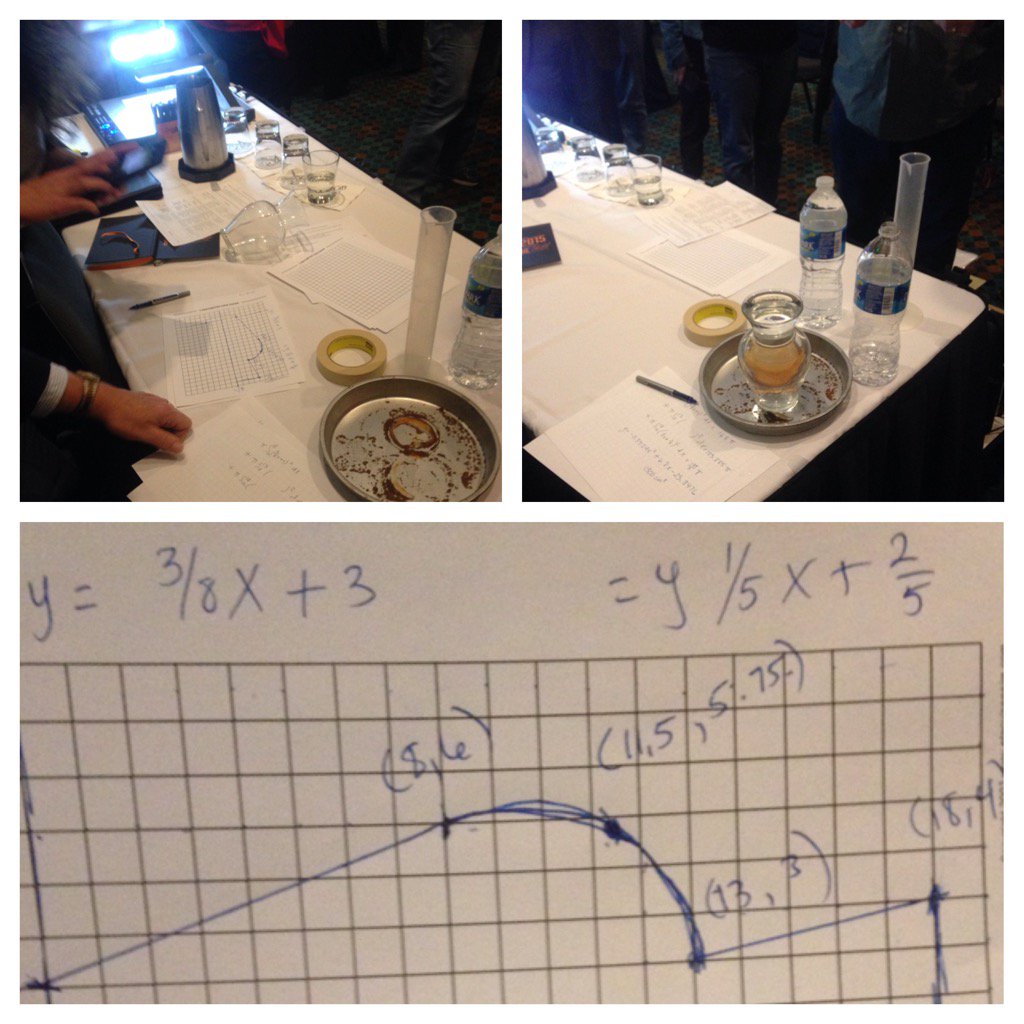
This possibility seems like more of a logistical issue than a conceptual one. I know how to make this a demanding task for kids and have seen amazing applications- from the "Goblet Design" project from my wonderful coworker or the vase volume performance task I had the opportunity to play around with at NCTM Nashville (shout out to Brett Doudican from Coordinated Achievement on this one). It would be fun to 3D print these to scale and then use displacement to check the accuracy of our volume calculations. There are so many ways to give kids constraints and have them develop something amazing. It's task-based and, more importantly, not a project for the sake of doing a project. 


Cross Sectional Volumes

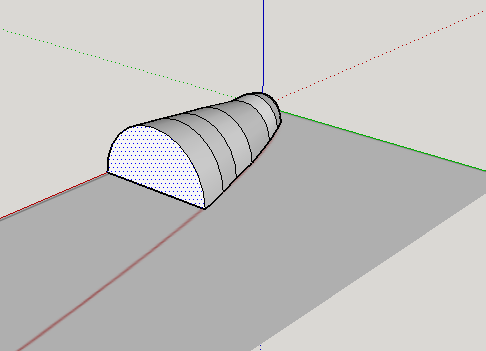
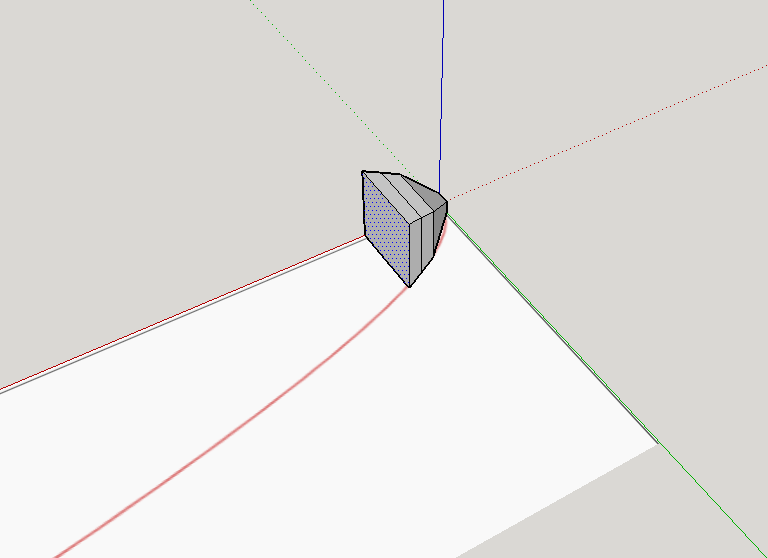
Logistically, I actually think this is easier. In about 15 minutes of playing around I was able to create 2 designs that would model different cross sections. My kids have experience with 3D printing...this wouldn't be mind blowing for them.  My struggle is having them print 3D models seems like the thing I hate most....a project for the sake of doing a project. Might it be a fun way to spend some time after the AP exam? Sure. But if I want to invest any time in this, I want it to be something that's worthwhile mathematically as well. I want something that can be low-floor, high-ceiling since our school ranges in ability level from Honors Calculus to BC Calculus (to a kid who is taking an MIT Quantum Physics MOOC for fun....seriously). Can you tell that I have lofty goals here?

So here's where I need my MTBoS friends...

What sort of tasks and applications do you associate with this topic?

I want to do more than just create a model, so how can I challenge my kids with creating a model within given constraints and do it meaningfully? My coworker and I have been trying to think of how to get kids to apply this concept in the real world and really use the model to serve a purpose. 

Please feel free to share, comment, and question!! We promise to tell you where this road leads us and share any resources along the way!